What's the Difference Between Amplifier and Operational Amplifier
What is an amplifier ?
An amplifier is a general term used to describe a device or circuit that increases the amplitude or power of a signal. It is used to boost the strength of a weak signal, allowing it to be transmitted or processed effectively.
What is an Operational amplifier ?
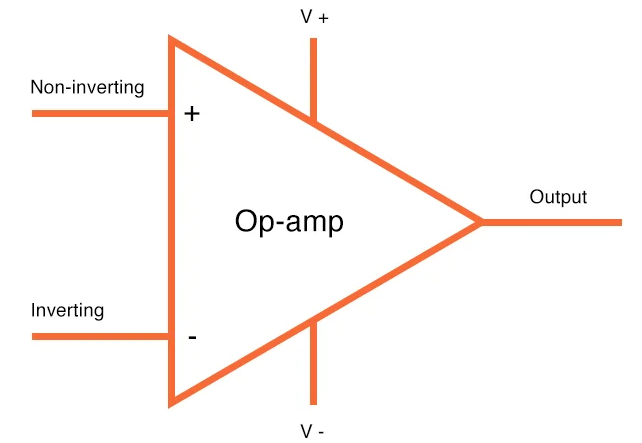
On the other hand, an operational amplifier (op-amp) is a specific type of amplifier with a high gain and differential input. It is designed to perform mathematical operations on analog signals, such as amplification, filtering, integration, differentiation, and more. Op-amps are widely used in various electronic applications, including signal conditioning, instrumentation, audio amplification, and feedback control systems.
Here are some key differences between a general amplifier and an operational amplifier:
Gain: An amplifier can have a variable or fixed gain, depending on the design and application. In contrast, an op-amp typically has a very high open-loop gain, often in the range of tens of thousands to hundreds of thousands.
Inputs: An amplifier may have a single input or multiple inputs, depending on its configuration. An op-amp always has two differential inputs and one output.
Feedback: Amplifiers can use various types of feedback configurations, such as voltage feedback or current feedback, to control the gain and performance. Op-amps are often used with negative feedback, which is essential for stability and precise control of the output.
Linearity: While amplifiers aim to provide linear amplification, op-amps are designed to have excellent linearity and accuracy in their operation. This is important for applications that require precise signal processing.
Power Supply: Amplifiers can operate from a wide range of power supply voltages, depending on the design. Op-amps typically require dual power supplies (positive and negative) to enable their full functionality and achieve rail-to-rail operation.
How they work?
An amplifier and an operational amplifier (op-amp) work differently based on their design and intended use. Here’s a brief explanation of how they work:
Amplifier:
An amplifier takes an input signal and increases its amplitude or power level.
It consists of active components such as transistors or operational amplifiers, as well as passive components like resistors and capacitors.
The input signal is applied to the input of the amplifier circuit, and the output signal is obtained from the output of the circuit.
The amplification process occurs within the active components of the circuit, which can be configured in different ways to achieve the desired amplification characteristics.
The amplifier can have various configurations, such as common emitter, common base, common collector (for transistor-based amplifiers), or inverting/non-inverting configurations (for op-amp-based amplifiers).
Operational Amplifier (Op-amp):
An op-amp is a high-gain differential amplifier with a very large open-loop gain.
It is designed to perform mathematical operations on analog signals, such as amplification, filtering, integration, differentiation, and more.
The op-amp has two differential inputs (inverting and non-inverting) and a single output.
The input differential voltage is amplified by the op-amp’s high gain, and the output voltage is obtained based on the difference between the two inputs.
The op-amp operates in two modes: open-loop mode and closed-loop mode. In open-loop mode, the op-amp amplifies the input signal without any external feedback. In closed-loop mode, negative feedback is applied to stabilize and control the gain of the op-amp.
The closed-loop configuration of an op-amp, along with external resistors and capacitors, determines its specific functionality, such as amplification, filtering, or other mathematical operations.


Related Articles

Multivibrators,Astable Oscillator,Crystal Oscillator:Distinction
TVS Diode Types,Working Principle,Testing,Selection
Ryzen 9 7950X3D vs 7900X3D,7950X,7900X,5950X,5900X,3950X,3900X
Mastering GND in Circuits: Essential Guide for Safety
Electronica 2024:Munich Electronic Components Exhibition
Vess Electronics Component Distributor at ExpoElectronica 2024
Fuses Choosing Tutorial Top 10 Fuses Recommendation For 2024
How to Choose RTC Real Time Clock? Structure,Operation,Types
Step Recovery Diode: Symbol, Types, and Applications
MEMS accelerometer:Working, Application, Pros & Cons
What are the 4 Types of Filters?Distinction & Selection Tutorial