PCF8563 vs DS1307:Arduino-Compatible Real-Time Clock (RTC)Module
Hello, my friends! PCF8563 vs DS1307:Arduino-Compatible Real-Time Clock (RTC) Modules Comparison

Introduction:
Real-Time Clock (RTC) modules are essential components for accurate timekeeping in Arduino projects. Two popular choices for RTC modules are the PCF8563 and the DS1307. In this article, we will compare the PCF8563 and DS1307 RTC modules, highlighting their differences and helping you choose the right one for your Arduino-based applications.
1. PCF8563 Overview:
The PCF8563 is an I2C-bus compatible RTC module manufactured by NXP Semiconductors. It offers highly accurate timekeeping capabilities with a built-in 32.768 kHz quartz crystal oscillator. The PCF8563 module features a 240-byte RAM for general-purpose storage and supports alarms and a timer function. It operates at a voltage range of 1.0V to 5.5V, making it suitable for low-power applications.
PCF8563 Pinout
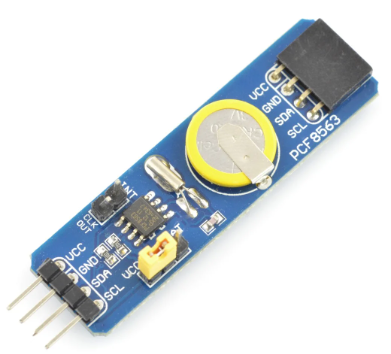

*PCF8563 Features
Provides year, month, day, weekday, hours, minutes, and seconds based on a 32.768 kHz quartz crystal.
Default PCF8563 I2C address: 0xA2
Clock operating voltage: 1.0 V to 5.5 V at room temperature
Low backup current; typical 0.25 mA at VDD = 3.0 V and Tamb = 25 °C
400 kHz two-wire I2C-bus interface (at VDD = 1.8 V to 5.5 V)
Programmable clock output for peripheral devices (32.768 kHz, 1.024 kHz, 32 Hz, and 1 Hz)
Alarm and timer functions
Integrated oscillator capacitor
Internal Power-On Reset (POR)
I2C-bus slave address: read A3h and write A2h.
Open-drain interrupt pin
*Other RTC ICs
DS1307, DS3231, DS1302, PCF8523, DS1820, DS1338,
Applications for PCF8563 RTC IC
·Mobile telephones
·Portable instruments
·Electronic metering
·Battery-powered products.
2. DS1307 Overview:
The DS1307, produced by Maxim Integrated, is another widely used I2C-based RTC module. It offers similar functionalities to the PCF8563, including a built-in 32.768 kHz crystal oscillator for precise timekeeping. The DS1307 has 56 bytes of non-volatile RAM and supports alarms. It operates at a voltage range of 4.5V to 5.5V.
*DS1307 Pinout

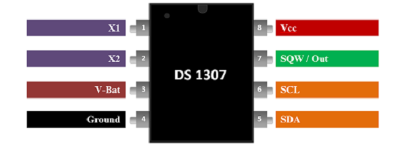
*DS1307 Features
I2C Interface RTC IC
Operating Voltage: 5V
Less than 500nA current when operating with battery
56bytes SVRAM
Operates in power or battery mode
Programmable square wave output pin
Available in PDIP and SO package
*Equivalent for DS1307: PCF8523, DS1820, DS1338
Other RTC IC’s: DS3231
*DS1307 Applications
· Robotics
· Gaming
· Servers
· Computer Peripherals
· GPS
· Utility power meters
3. Accuracy and Precision:
Both the PCF8563 and DS1307 modules provide accurate timekeeping, with deviations typically in the range of a few seconds per month. However, the PCF8563 tends to offer slightly better accuracy due to its integrated calibration feature, which compensates for crystal oscillator inaccuracies.
4. Power Consumption:
The PCF8563 is known for its low power consumption, making it an excellent choice for battery-powered applications. It has a typical operating current of around 0.35 μA and a backup current of 0.2 μA. On the other hand, the DS1307 consumes slightly more power, with a typical operating current of approximately 0.5 mA and a backup current of 1.2 μA.
5. Additional Features:
While both modules support alarms, there are some differences in their additional features:
- The PCF8563 offers a timer function, allowing you to set a specific time interval for triggering events.
- The DS1307 has 56 bytes of non-volatile RAM that can be used for storing data even when power is lost. This feature can be useful for data logging or storing configuration settings.
6. Availability and Cost:
Both the PCF8563 and DS1307 modules are readily available in the market. However, the DS1307 is more commonly found due to its popularity. As a result, the DS1307 may be slightly cheaper and easier to source compared to the PCF8563.
7. Compatibility with Arduino:
Both the PCF8563 and DS1307 modules are compatible with Arduino boards. Libraries are available for both modules, simplifying the integration process. The libraries provide functions for setting and reading the time, configuring alarms, and accessing additional features.
PCF8563 vs DS1307 Application
PCF8563:
Battery-Powered Devices: The PCF8563's low power consumption makes it ideal for applications that operate on battery power. This includes portable data loggers, wearable devices, and remote sensing systems.
Timers and Alarms: The PCF8563's timer function allows for the implementation of time-based triggers and scheduling. It can be used in applications such as wake-up alarms, event scheduling, and time-based reminders.
Home Automation: The PCF8563 can be utilized in home automation systems for time-based tasks such as turning lights on/off at specific times, controlling irrigation systems, or managing energy consumption.
Data Logging: The PCF8563's onboard RAM can be used to store timestamped data logs, making it suitable for applications like environmental monitoring, weather stations, or industrial data collection.
DS1307:
Digital Clocks and Calendars: The DS1307 is commonly used in digital clocks, wall clocks, and calendar displays due to its accurate timekeeping capabilities. It provides real-time updates and accurate time display.
Data Logging and Event Timestamping: The DS1307's non-volatile RAM allows for storing data logs or timestamps for events in applications such as data acquisition systems, event logging, or industrial automation.
Security Systems: The DS1307 can be used in security systems that require timestamps for events such as access control systems, surveillance systems, or logging of security breaches.
Automation and Control Systems: The DS1307 provides accurate timekeeping for automation and control systems, enabling precise scheduling of tasks, event synchronization, and time-based control of devices.
package

PCF8563 package

DS1307 package
Conclusion:
When choosing between the PCF8563 and DS1307 RTC modules for your Arduino projects, consider your specific requirements. If low power consumption is critical or if you need a timer function, the PCF8563 might be the better choice. On the other hand, if you require non-volatile RAM or prefer a more widely available module, the DS1307 is a reliable option. Ultimately, both modules offer accurate timekeeping and can enhance the functionality of your Arduino projects.


Related Articles

STM8S003F3P6TR 8-bit Microcontrollers Datasheet, Pinout, Schematic
ULN2803ADWR vs ULN2003APWR Array Driver IC: Datasheet
What is STM32F103CBT6 Microcontroller?STM32F103CBT6 Vs STM32F103C8T6
TXS0108EPWR Voltage Translator Datasheet,Pinout,Features
TDA7294 Vs TDA7293 Vs TDA7266 Audio Amplifier:Pinout,Datasheet
TOP247YN Power Converter: Pinout, Datasheet, Circuit Diagram
How Does PC817 Optocoupler Work? Datasheet, Pinout, Equivalent
What is STM32G070CBT6TR Microcontroller? Datasheet, Pinout
What is SPC58EC70E3F000X Microcontroller: Datasheet
DLW5BTM501SQ2L Multilayer Ceramic Capacitor (MLCC) Datasheet
NRF52840, NRF5340, and NRF52833 Microcontrollers,Which is Best?