What Are Biosensors Used For And How Does It Work?
Catalog
*The history of Biosensors
*What is Biosensors
*What are some examples of biosensors used in medical diagnostics?
*How do biosensors work?
*Structure of Biosensors
*Types of Biosensors
*Classification of biosensor
*The history of Biosensors
Biosensors have a rich history that spans several decades, evolving from simple detection tools to sophisticated devices used in various fields today. Here is a brief overview of the history of biosensors:
Early Developments$ (1960s-1970s)$: The concept of biosensors began to take shape in the 1960s and 1970s with the work of scientists like Leland C. Clark and Clark Still. They developed the first enzyme-based biosensor, known as the Clark electrode, which measured glucose levels using an enzyme electrode.
Commercialization and Diversification$ (1980s)$: In the 1980s, biosensors started to be commercialized for various applications, particularly in the medical field for monitoring glucose levels in diabetic patients. This decade saw advancements in enzyme-based biosensors and the introduction of new types of biosensors, such as immunosensors.
Technological Advancements$ (1990s)$: The 1990s saw significant technological advancements in biosensors, including improvements in sensor sensitivity, miniaturization, and the development of new detection techniques. This period also saw the integration of biosensors into various industries, including environmental monitoring and food safety.
Nanotechnology and Microfabrication$ (2000s)$: The 2000s marked a shift towards the use of nanotechnology and microfabrication techniques in biosensor development. These advancements allowed for the creation of miniaturized and highly sensitive biosensors for a wide range of applications.
Expansion of Applications$ (2010s-Present)$: In recent years, biosensors have found applications beyond traditional fields such as healthcare and environmental monitoring. They are now used in areas like food safety, security, agriculture, and biodefense. The integration of biosensors with wireless technology and data analytics has also enabled real-time monitoring and remote sensing capabilities.
*What is Biosensors
![BGP(E3YA_}291Y@68WM]GTR](/upload/image/content/20240219/5c0e2970186dc80bd22905b2e70e7221.png "5c0e2970186dc80bd22905b2e70e7221.png")
What are biosensors used for? Biosensors are used to detect, record, and transmit information regarding a biological process. They are commonly used in various fields such as healthcare, environmental monitoring, food and beverage industry, and biomedical research. In healthcare, biosensors can be used for detecting biomarkers, monitoring glucose levels, and diagnosing diseases. In environmental monitoring, biosensors can detect pollutants and toxins. In the food and beverage industry, biosensors can be used to detect pathogens and ensure food safety. In biomedical research, biosensors can be used to study biological processes and develop new drugs.
*What are some examples of biosensors used in medical diagnostics?
1. Glucose Biosensors: These biosensors are widely used by people with diabetes to monitor their blood glucose levels. They typically use an enzyme called glucose oxidase to detect glucose and produce an electrical signal that can be measured.
2. Pregnancy Test Kits: These biosensors are used to detect the presence of human chorionic gonadotropin (hCG), a hormone produced during pregnancy. They typically use antibodies that bind specifically to hCG, causing a color change or other visual indication.
3. Lateral Flow Immunoassays: These biosensors are used for rapid and point-of-care testing. They employ antibody-antigen interactions to detect specific analytes, such as infectious agents or biomarkers of diseases like HIV, malaria, or influenza.
4. Cardiac Biomarker Biosensors: These biosensors are used to detect biomarkers associated with heart conditions, such as troponin and B-type natriuretic peptide (BNP). They can help in the diagnosis of heart attacks, heart failure, and other cardiac conditions.
5. DNA Biosensors: These biosensors are used for genetic testing and identification of specific DNA sequences. They often employ complementary DNA strands or probes to detect and quantify the presence of specific genes or genetic mutations.
6. Biosensors for Infectious Diseases: Biosensors are being developed for the rapid detection of infectious diseases, including viruses, bacteria, and parasites. For example, biosensors have been developed for the detection of Zika virus, dengue fever, and tuberculosis.
*How do biosensors work?
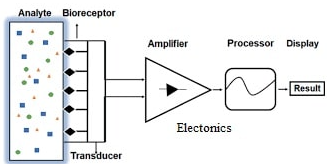
Biosensors work by combining a biological element (such as enzymes, antibodies, or living cells) with a transducer that converts the biological response into a measurable signal. The biological element interacts with the target analyte or substance of interest, leading to a specific biological response. This response is then converted into a measurable signal by the transducer.
*Structure of Biosensors
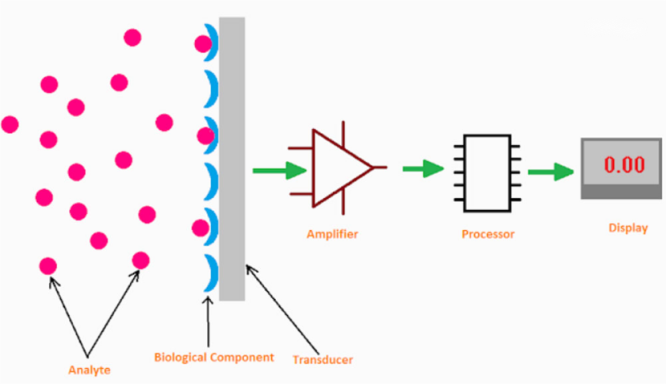
The basic components of a biosensor include:
1. Biological recognition element: This element selectively interacts with the target analyte, often through specific binding reactions. Examples include antibodies that bind to specific antigens or enzymes that catalyze specific reactions.
2. Transducer: The transducer converts the biological response into a measurable signal, which can be electrical, optical, or electrochemical in nature. The choice of transducer depends on the type of biosensor and the desired output.
3. Signal processing system: The generated signal is processed and amplified to provide a reliable measurement. This may involve analog-to-digital conversion, filtering, and data analysis.
The interaction between the biological recognition element and the target analyte leads to a change in the physicochemical properties of the biosensor, such as conductivity, pH, optical properties, or electrochemical potential. This change is then translated into a measurable signal by the transducer. The intensity of the signal is often proportional to the concentration or presence of the target analyte, allowing quantitative analysis.
Different types of biosensors exist, including optical biosensors, electrochemical biosensors, piezoelectric biosensors, and more. Each type utilizes different mechanisms to convert the biological response into a measurable signal. The choice of biosensor depends on the specific application and the properties of the target analyte being detected.
*Classification of biosensor
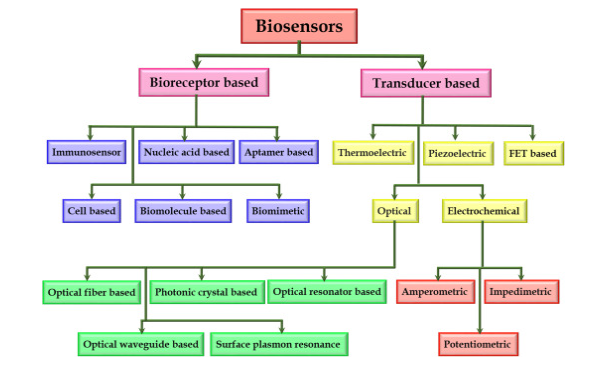
Biosensors can be classified based on different criteria. Here are a few common classification methods for biosensors:
1. Transduction Principle:
- Optical Biosensors: These biosensors utilize light-based detection methods, such as absorption, fluorescence, or surface plasmon resonance (SPR), to measure the biological response.
- Electrochemical Biosensors: These biosensors use electrochemical techniques, such as amperometry, potentiometry, or impedance spectroscopy, to convert the biological response into an electrical signal.
- Piezoelectric Biosensors: These biosensors utilize the piezoelectric effect, where the binding of the target analyte causes a change in the mechanical properties of the biosensor, leading to a measurable change in the frequency or resonance of a piezoelectric crystal.
- Thermal Biosensors: These biosensors measure changes in temperature resulting from the biological interaction between the recognition element and the target analyte.
2. Nature of the Biological Recognition Element:
- Enzymatic Biosensors: These biosensors use enzymes as the recognition element to catalyze specific reactions in the presence of the target analyte.
- Immunosensors: These biosensors use antibodies or antibody fragments as the recognition element to specifically bind to antigens or other analytes.
- DNA Biosensors: These biosensors use DNA or DNA-based molecules as the recognition element to detect and measure the presence of specific DNA sequences or genetic mutations.
- Whole-Cell Biosensors: These biosensors employ intact living cells as the recognition element to detect and respond to specific analytes or environmental conditions.
3. Application:
- Clinical Biosensors: These biosensors are used in medical diagnostics and healthcare applications, such as monitoring glucose levels, detecting infectious diseases, or measuring biomarkers.
- Environmental Biosensors: These biosensors are designed for monitoring and detecting pollutants, toxins, or environmental parameters in air, water, or soil.
- Food and Agriculture Biosensors: These biosensors are used in the food industry for detecting contaminants, pathogens, or quality parameters in food products.
- Industrial Biosensors: These biosensors find applications in industries such as bioprocessing, fermentation monitoring, or quality control.
*Types of Biosensors
Biosensors can be categorized into various types based on their transduction principle, the nature of the biological recognition element, and their application. Here are some common types of biosensors:
1. Optical Biosensors:
- Absorbance-based biosensors
- Fluorescence-based biosensors
- Surface Plasmon Resonance (SPR) biosensors
- Bioluminescent biosensors
- Reflectance biosensors
2. Electrochemical Biosensors:
- Amperometric biosensors
- Potentiometric biosensors
- Conductometric biosensors
- Impedance-based biosensors
3. Piezoelectric Biosensors:
- Quartz Crystal Microbalance (QCM) biosensors
- Surface Acoustic Wave (SAW) biosensors
4. Thermal Biosensors:
- Calorimetric biosensors
- Thermistor-based biosensors
5. Enzymatic Biosensors:
- Glucose biosensors (used for glucose monitoring)
- Lactate biosensors (used for lactate measurement)
- Cholesterol biosensors (used for cholesterol detection)
6. Immunosensors:
- Antibody-based biosensors (utilizing antibodies as recognition elements)
- Antigen-based biosensors (utilizing antigens as recognition elements)
7. DNA Biosensors:
- DNA hybridization biosensors
- Nucleic acid amplification-based biosensors
8. Whole-Cell Biosensors:
- Microbial biosensors (using genetically modified microorganisms)
- Plant-based biosensors
9. Gas Biosensors:
- Oxygen biosensors
- Carbon dioxide biosensors
- Volatile organic compound (VOC) biosensors
10. Nanostructured Biosensors:
- Nanowire biosensors
- Nanoparticle-based biosensors
11. Implantable Biosensors:
- Biosensors designed for implantation in the body for continuous monitoring of physiological parameters, drug levels, etc.


Related Articles

Multivibrators,Astable Oscillator,Crystal Oscillator:Distinction
TVS Diode Types,Working Principle,Testing,Selection
Ryzen 9 7950X3D vs 7900X3D,7950X,7900X,5950X,5900X,3950X,3900X
Mastering GND in Circuits: Essential Guide for Safety
Electronica 2024:Munich Electronic Components Exhibition
Vess Electronics Component Distributor at ExpoElectronica 2024
Fuses Choosing Tutorial Top 10 Fuses Recommendation For 2024
How to Choose RTC Real Time Clock? Structure,Operation,Types
Step Recovery Diode: Symbol, Types, and Applications
MEMS accelerometer:Working, Application, Pros & Cons
What are the 4 Types of Filters?Distinction & Selection Tutorial