SS14 vs SS34 vs SS54 Schottky Power Diode: Pinout, Price & PDF

SS14 vs SS34 vs SS54
Introduction
What is GSM module?
Overview of SS14
Overview of SS34
Overview of SS54
SS14 vs SS34 vs SS54 Pinout
SS14 vs SS34 vs SS54 Price
SS14 vs SS34 vs SS54 CAD model
SS14 vs SS34 vs SS54 Features
SS14 vs SS34 vs SS54 Application
SS14 vs SS34 vs SS54 Package
Datasheet
Introduction
In this article, we will be comparing three popular GSM modules, namely the SS14, SS34, and SS54. These modules are used in a wide range of electronic devices for data communication and remote control over cellular networks. A detailed examination of their features, applications, pinouts, CAD models, packaging, and datasheets will help us understand their differences and similarities.
What is GSM module?
The GSM module is essential for communication between devices and the GSM network. It is in charge of establishing and maintaining the device's communication relationship with the network. The module also handles data encryption and decryption, ensuring the communication's security.
SS14 Overview
The SS14 is a high-performance GSM module from Siemens that supports quad-band GSM/EDGE communication. It provides data rates up to 296 kbps and features a high level of integration, making it suitable for a variety of applications. The module is available in both surface-mount and through-hole packaging options.
SS34 Overview
The SS34 is a dual-band GSM/EDGE module from STMicroelectronics that supports GSM bands 850/900 MHz. It provides data rates up to 22.8 kbps and is designed for low power consumption, making it suitable for use in battery-powered devices. The module is available in both surface-mount and through-hole packaging options.
SS54 Overview
The SS54 is a quad-band GSM/EDGE module from NXP that supports GSM bands 850/900/1800/1900 MHz. It provides data rates up to 384 kbps and features a high level of integration, making it suitable for a variety of applications. The module is available in both surface-mount and through-hole packaging options.
SS14 vs SS34 vs SS54 Pinout
The SS14, SS34, and SS54 modules have different pinouts, reflecting their different designs and functionalities. The SS14 features the highest number of pins, followed by the SS54 and then the SS34. The specific pin assignments and functions vary between models, but the general functions include power supply, data communication, and RF interface pins.
SS14 Pinout

Alternative for SS14: 1N5819, SS12, SS13, SS15, SS16
Other Schottky Diodes: 1N4148, 1N4733A,
SS34 Pinout
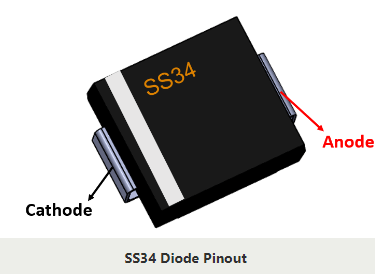
Alternative for SS34: SS32, SS33, SS35, 1N5822
Other Diodes: 1N4148, 1N4733A, 1N5824
SS54 Pinout

Alternative for SS54: SS52, SS53, SS54, SS56, 1N5824
Other Schottky Diodes: IN5822, 1N4148, 1N4002
SS14 vs SS34 vs SS54 CAD Model
SS14 vs SS34 vs SS54 Features
The SS14, SS34, and SS54 modules have different features that make them suitable for different applications. The SS14 provides high data rates and a high level of integration, making it suitable for high-speed data communication applications. The SS34 excels in low power consumption, making it suitable for battery-powered devices. The SS54 provides medium data rates and is also suitable for most GSM applications due to its quad-band support.
SS14
SMA Schottky Barrier rectifier
Forward Current (IF): 1A
Maximum Forward Voltage (VF): 0.5V (@1A)
Reverse Current (IR): 0.5 mA
Maximum DC Blocking Voltage: 40V
Diode Marking: S4
Available in SMA DO-214AC, SOD126 and 403D Package
SS34
Power Schottky Barrier Diode
Forward Current (IF): 3A
Maximum Forward Voltage (VF): 0.5V (@3A)
Reverse Current (IR): 0.5mA
Maximum DC Blocking Voltage: 40V
Diode Marking: S4
Available in SMC DO-214AB and DO-214AA Package
SS54
SMC Schottky Barrier rectifier
Forward Current (IF): 5A
Maximum Forward Voltage (VF): 0.55V (@5A)
Reverse Current (IR): 1.5 mA
Maximum DC Blocking Voltage: 40V
Available in SOD-123W Package
SS14 vs SS34 vs SS54 Application
The SS14, SS34, and SS54 modules are suitable for a range of applications including remote monitoring, asset tracking, data logging, alarm systems, and more. The SS14 is particularly suitable for high-speed data communication applications such as video streaming or high-resolution image transfer. The SS34 is particularly suitable for battery-powered devices that require long standby times between charges. The SS54 is suitable for most standard GSM applications due to its quad-band support:
Applications of Diode
Can be used to prevent reverse polarity problem
High-Frequency Inverters
Used as a protection device
Current flow regulators
Polarity Protection applications
SS14 vs SS34 vs SS54 Package
The SS14, SS34, and SS54 modules are available in both surface-mount and through-hole packaging options. Surface-mount packaging allows for smaller board sizes, higher component density, and easier automation of assembly processes. Through-hole packaging allows for easier manual assembly and repair but requires more space on the circuit board. Designers can choose the packaging type based on their specific requirements.
SS14 vs SS34 vs SS54 Datasheet


Frequently Asked Questions
Related Articles

2N5551 vs BC547 BJTs Comparison
LM3914 vs LM3915 vs LM3916 vs LM3917 How They Work?
Top 12 electronic component distributors 2024
TPS5450DDAR Datasheet, Pinout, Specification
C945 Transistor Datasheet:C1815 VS C945 Comparison
Lithium Battery Charger TP4056: Datasheet, Schematic, Price
TDA7265 Audio Amplifier:How To Connect And Test?
1n4007 vs 1n5399 Rectifier Diode: Pinout, Datasheet, Specifications
SN74HC595N vs SN74HC574N Shift Register Datasheet,Specs
H6 vs H7 vs H8 vs H9 Battery Difference and Choosing Guide
ADRV9009BBCZ RF Description, Datasheet, Specification