C945 Transistor Datasheet:C1815 VS C945 Comparison
yunying Release time:2024-04-18 Page View:3199
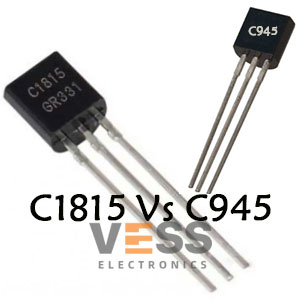
What is the C945 Transistor?
The C945 transistor is an NPN silicon bipolar junction transistor (BJT) manufactured by ON Semiconductor. It is a general-purpose transistor widely used in various circuits, including amplifiers, switches, and drivers. The C945 features high current gain, low saturation voltage, and fast switching speed.
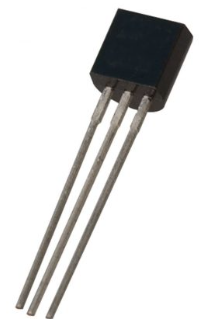
C945 Pinout
* NPN silicon BJT
* Collector-Emitter Voltage (Vce): 45V
* Collector Current (Ic): 150mA
* Base Current (Ib): 15mA
* Current Gain (hFE): 100 (typical)
* Frequency Range: 100MHz
* Package: TO-92
C945 Pinout
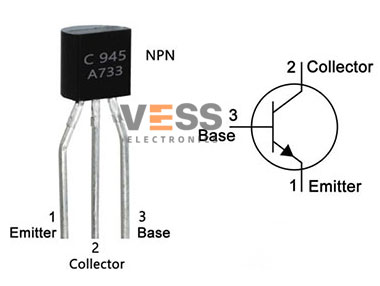
The C945 transistor has three pins:
Base (B): The input terminal that controls the transistor's current.
Collector (C): The output terminal connected to the load to be controlled.
Emitter (E): The common terminal connected to the negative side of the power supply.
C945 CAD Model
The C945's CAD model is available on the ON Semiconductor website and can be used for circuit design and simulation.
C945 Symbol
The C945 symbol is a standard NPN transistor symbol
C945 Footprint

The C945 transistor comes in a TO-92 package with dimensions of 4.5mm x 4.5mm x 9.5mm.
C945 3D Model
The C945 3D model can be found on the ON Semiconductor website and can be used for visualization and design purposes.
C945 Applications
The C945 npn transistor can be used in various applications, including:
* Amplifiers
* Switches
* Drivers
* Power circuits
* Logic circuits
C945 Circuits
The C945 transistor can be used in various circuits. Here is an example of a simple amplifier circuit:
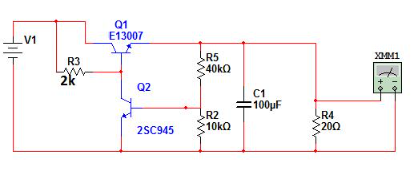
C945 Amplifier Circuit
C945 Package Dimensions
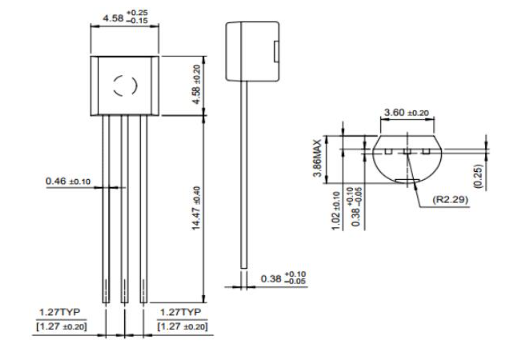
The C945 transistor comes in a TO-92 package with the following dimensions:
* Length: 9.5mm
* Width: 4.5mm
* Height: 4.5mm
C945 Datasheet
The C945 transistor datasheet can be found on the ON Semiconductor website. The c945 datasheet pdf contains detailed information about the C945's parameters, characteristics, and application information.
C945 Equivalents
The C945 transistor's equivalents include:
* BC547, BC546
* 2N2222, 2N3904,
* C1815, KSC945C, 2SC1815, 2SC3198,S8050
How to Use the C945
The C945 transistor needs to be selected and used according to its characteristics and application. When using the C945 transistor, consider the following factors:
* Voltage and current requirements
* Current gain
* Frequency range
* Package size
C1815 VS C945 Comparison
C1815 and C945 are both NPN silicon BJTs, but they have some key differences. C1815 has a higher current gain (hFE: 200) but a lower collector-emitter voltage (Vce: 30V). C945 has a lower current gain (hFE: 100) but a higher collector-emitter voltage (Vce: 45V).
C1815 VS C945 How to choose?
Choosing between C1815 and C945 depends on the specific application requirements. If a higher current gain is needed, C1815 can be chosen. If a higher collector-emitter voltage is required, C945 can be chosen.
C1815 VS C945 Operation
How does C1815 work?
How does C945 work?
C1815 VS C945 Comparison and Operation
Both C1815 and C945 are NPN silicon bipolar junction transistors (BJTs) commonly used in various electronic circuits. While they share similar functionalities, they differ in specific characteristics, making them suitable for different applications.
C1815 VS C945 Key Differences:
Current Gain: C1815's higher current gain (hFE) amplifies input signals more effectively, making it suitable for applications requiring high amplification. C945's lower gain makes it more suitable for switching applications where precise control of current is needed.
Collector-Emitter Voltage: C945's higher Vce rating allows it to handle higher voltage loads compared to C1815. This makes C945 suitable for applications with higher voltage requirements.
Operation: Both transistors operate similarly, with the base current controlling the collector current. However, due to the differences in hFE, a smaller base current is needed for C1815 to achieve the same collector current as C945.
Choosing the Right Transistor:
High amplification: Choose C1815 for applications requiring high gain, such as audio amplifiers or pre-amplifiers.
High voltage handling:Choose C945 transistor for applications with higher voltage requirements, such as motor drivers or power circuits.
Switching applications: C945's precise current control makes it suitable for switching applications like relays or LED drivers.
Ultimately, the choice between C1815 and C945 depends on the specific application requirements and desired characteristics. Consider the voltage, current, and gain requirements to determine the most suitable transistor for your project.
References
* [ON Semiconductor C945 Datasheet](https://www.onsemi.com/pub/Collateral/C945-D.PDF)
* [Wikipedia C945 Transistor](https://en.wikipedia.org/wiki/C945_transistor)
Additional Resources:
C945 Transistor Datasheet: https://www.onsemi.com/pub/Collateral/C945-D.PDF
BC547 Transistor Datasheet: https://www.onsemi.com/pub/Collateral/BC547-D.PDF
Multimeter Tutorial:
https://www.electronics-tutorials.ws/accircuits/meter-multimeter.html
Other comparison yhou may want to know: C945 VS BC547, C945 VS 2N3904
Related articles
Specifications
- Manufacturer :
- Product Category :
- Current - Collector (Ic) (Max) :
- 150mA
- Package / Case :
- SOT-23(SOT-23-3)
- Packaging :
- Tape & Reel (TR)
- Power - Max :
- 200mW
- RoHS Status :
- RoHS Compliant
- Transistor Type :
- NPN
- Voltage - Collector Emitter Breakdown (Max) :
- 50V
Datasheets
- Datasheets
- C945
- Share this post
-


Frequently Asked Questions
Are transistors bc547 and c945 the same?
No, BC547 and C945 transistors are not the same, although they share some similarities. Here's a breakdown of their key differences: Collector-Emitter Voltage: BC547 has a higher Vce (45V) compared to C945 (30V). This means BC547 can handle higher voltage loads. Collector Current: C945 has a higher maximum collector current (150mA) compared to BC547 (100mA). This allows C945 to handle larger currents. Current Gain: Both transistors have similar current gains, but BC547's hFE is slightly higher (110) than C945 (100).
How to check c945 transistor?
Identify the pinout configuration of the C945 transistor. It has three terminals: emitter (E), base (B), and collector (C) Use a multimeter in diode mode to test the transistor. Connect the positive lead of the multimeter to the base terminal (B) and the negative lead to the emitter terminal (E). The multimeter should display a voltage drop between 0.6V to 0.75V, indicating that the base-emitter junction is functioning properly Reverse the leads of the multimeter, connecting the positive lead to the emitter terminal (E) and the negative lead to the base terminal (B). The multimeter should display an open circuit or a very high resistance, indicating that the base-emitter junction is not conducting in reverse bias Repeat the same steps for the collector-emitter junction by connecting the positive lead to the collector terminal (C) and the negative lead to the emitter terminal (E) The multimeter should display an open circuit or a very high resistance, indicating that the collector-emitter junction is not conducting
How to test c945 transistor?
Testing a C945 transistor in a circuit is more complex than testing it individually. It involves analyzing the transistor's behavior within the circuit and comparing it to expected values. Here are some general steps: Identify the circuit: Understand the function of the circuit and how the transistor is used. Measure voltages and currents: Use a multimeter to measure the voltages and currents at various points in the circuit. Compare with expected values: Compare the measured values with the expected values based on the circuit design and the transistor's datasheet. Analyze the behavior: Analyze the transistor's behavior based on the measurements and identify any anomalies.
Related Articles

2N5551 vs BC547 BJTs Comparison
LM3914 vs LM3915 vs LM3916 vs LM3917 How They Work?
Top 12 electronic component distributors 2024
TPS5450DDAR Datasheet, Pinout, Specification
C945 Transistor Datasheet:C1815 VS C945 Comparison
Lithium Battery Charger TP4056: Datasheet, Schematic, Price
TDA7265 Audio Amplifier:How To Connect And Test?
1n4007 vs 1n5399 Rectifier Diode: Pinout, Datasheet, Specifications
SN74HC595N vs SN74HC574N Shift Register Datasheet,Specs
H6 vs H7 vs H8 vs H9 Battery Difference and Choosing Guide

-
1,000+Daily Order Quantity
-
2,500,000+Alternative Parts
-
2,200+Worldwide Manufacturers
-
10,000 ㎡In-stock Warehouse