Lithium Battery Charger TP4056: Datasheet, Schematic, Price
TP4056 datasheet pdf TPOWER ESOP-8 stock available at Vess
1. What is TP4056 Charging Module?
The TP4056 is a highly integrated and easy-to-use single-cell lithium-ion battery charger module. It features a constant current/constant voltage (CC/CV) charging algorithm, ensuring safe and efficient charging of lithium-ion batteries. The module integrates various protection features, including over-charge, over-discharge, and over-current protection, enhancing battery life and safety.
Equipped with TP4056 adjustable current & protection, TP4056 is a comprehensive linear charger for single-cell lithium-ion batteries that provides consistent current and voltage. The TP4056's SOP packaging and low external component count make it excellent for portable applications. Furthermore, the TP4056 is compatible with both USB and wall adapters.
The integrated PMOSFET construction eliminates the need for a blocking diode and prevents a negative charge current circuit. Thermal feedback modulates charge current to keep the die from overheating during high power operation or high ambient temperatures. The charge voltage is fixed at 4.2V, and the charge current can be controlled externally using a single resistor. After reaching the final float voltage, the TP4056 automatically terminates the charge cycle when the charge current reduces to 1/10th of the specified value.
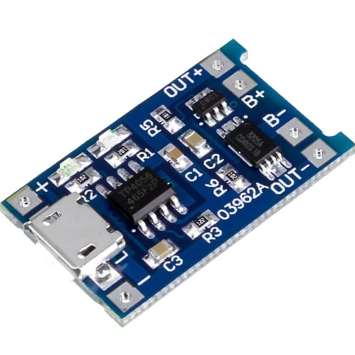
TP4056 output voltage:
The TP4056 is a lithium-ion battery charger IC that provides a constant current/constant voltage charging method. It is commonly used for charging single-cell lithium-ion batteries and offers protection against overcharging and undercharging. The TP4056 has an input voltage range of 4V to 8V and a programmable charge current of up to 1A
The output voltage of the TP4056 depends on the charging state and the connected load. Here are the key points regarding the TP4056 output voltage:
1. Charging State:
- During the charging process, the TP4056 maintains a constant voltage of 4.2V on the battery terminals [[2]](https://www.best-microcontroller-projects.com/tp4056.html).
- When the charging is complete, the TP4056 stops the charging process and the output voltage drops to a lower level, typically around 3.9V to 4.1V [[1]]
2. Load Connection:
- When a load is connected to the TP4056 while charging, it is recommended to switch off the load to prevent potential issues. The TP4056 may not detect when the charge current has fallen to C/10 if a load is attached, which could lead to overcharging.
3. TP4056 Module:
- The TP4056 module typically includes additional components such as the DW01A battery protection IC and the FS8205A dual MOSFET
- The TP4056 module's output voltage can be used to power external devices or circuits, but it is important to note that the output voltage may not be the same as the battery voltage
Source: TP4056 datasheet
2. TP4056 Pinout

The TP4056 module has eight pins with the following functions:
VIN: Input voltage (4.5V to 5.5V)
GND: Ground
BAT+: Battery positive terminal
BAT-: Battery negative terminal
PROG: Programming pin for setting the charging current (1A or 2A)
CE: Chip enable pin (active low)
STAT: Status output pin (indicates charging status)
NTC: Thermistor input pin for temperature monitoring
3. TP4056 CAD-Model
TP4056 Symbol

TP4056 Footprint
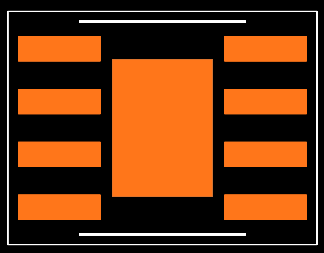
TP4056 3D-Model

The TP4056 CAD model is available from various sources, including the manufacturer's website and online component libraries. This model allows users to integrate the TP4056 into their circuit designs using electronic design automation (EDA) tools.
4. TP4056 Features
The key features of the TP4056 include:
*Constant current/constant voltage (CC/CV) charging: Ensures safe and efficient charging of lithium-ion batteries.
*Adjustable charging current: 1A or 2A selectable through the PROG pin.
*Built-in pre-charge function: Activates for deeply discharged batteries, preventing damage.
*Over-charge, over-discharge, and over-current protection:** Enhances battery life and safety.
*Low standby current consumption: Minimizes power consumption when not charging.
*Small footprint: Enables easy integration into compact designs.
5. TP4056 Equivalents
Several other battery charger modules offer similar functionality to the TP4056 lithium battery charger, including:
MCP73831: Offers similar features with a slightly higher charging current (1.2A).
BQ24072: A more advanced charger with additional features like thermal regulation and battery balancing.
LTC4054: A high-efficiency charger with programmable charging parameters.
6. TP4056 Applications
The TP4056 charger finds applications in various scenarios where single-cell lithium-ion batteries need charging, including:
Portable electronics: Smartphones, tablets, power banks, etc.
Wearable devices: Smartwatches, fitness trackers, etc.
IoT devices: Sensors, actuators, etc.
Battery-powered tools: Cordless drills, screwdrivers, etc.
DIY projects: Hobbyist electronics, robotics, etc.
7. TP4056 Typical Applications
Some typical applications of the TP4056 include:
Charging a single-cell lithium-ion battery in a portable device
Implementing a battery charging circuit for a DIY project
Replacing a damaged or faulty battery charger module
TP4056 Circuit Schematic
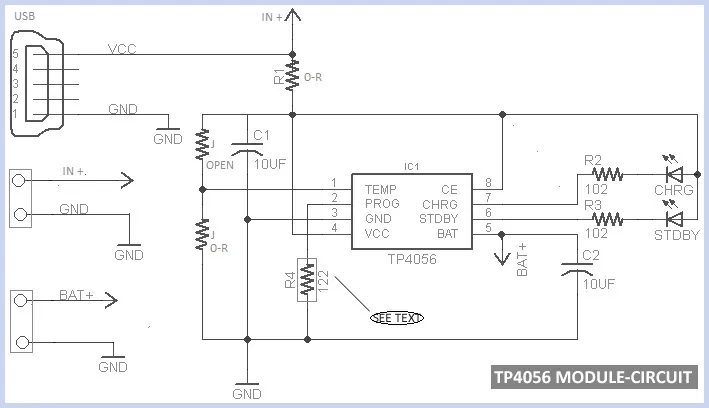
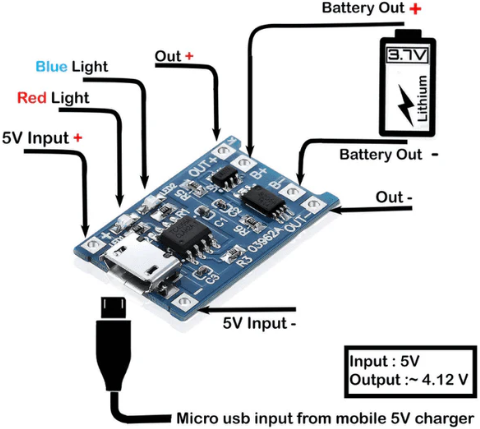
TP4056 Circuit Diagram
8. Where and How to Use TP4056
The TP4056 module is available from various online and offline electronics retailers. It can be easily integrated into circuits using a few external components like resistors and capacitors. The TP4056 datasheet provides detailed information on its operation, pinout, and application circuits.
9. TP4056 Package Dimension
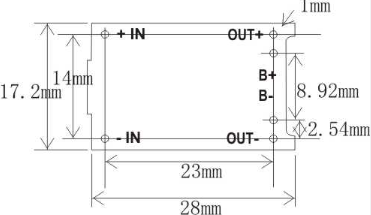
TP4056 battery charging module is available in a small SOT23-5 package, measuring 2.9mm x 2.8mm x 1.1mm. This compact size makes it suitable for space-constrained applications.
10. TP4056 Price
Individual modules: Prices for individual TP4056 modules typically range from $0.50 to $2.00.
Bulk purchases: Buying in bulk can significantly reduce the price per module. For example, a pack of 10 TP4056 modules might cost around $5.00 to $10.00.
Here are some resources where you can find TP4056 modules:
Online retailers:
AliExpress
Amazon
eBay
Electronics stores:
Adafruit
SparkFun
Wholesalers:
Alibaba
11. MCP73831 VS TP4056
Both MCP73831 and TP4056 are popular single-cell lithium-ion battery charger modules. The MCP73831 offers a slightly higher charging current (1.2A) compared to the TP4056 (1A or 2A). However, the TP4056 has a lower standby current consumption and a smaller footprint.
12. TP4054 Vs TP4056 VS TP4057
I saw many guys are asking the difference between tp4054 vs tp4056, or TP4056 Vs TP4057, so here is the comparison.
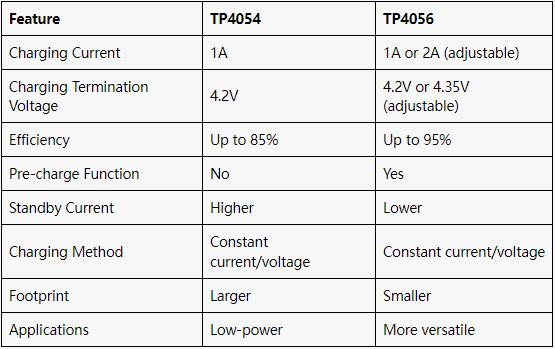

The TP4054, TP4056, and TP4057 are all single-cell lithium-ion battery charger modules from the same manufacturer. The TP4054 is the oldest and simplest version, offering a fixed 1A charging current.
The TP4056 is an improved version with adjustable charging current (1A or 2A) and additional features like pre-charge and lower standby current.
The TP4057 is the most advanced version, featuring a higher efficiency (up to 95%) and a smaller footprint.
Conclusion
The TP4056 battery charger is a versatile and reliable single-cell lithium-ion battery charger module suitable for various applications. Its ease of use, affordability, and comprehensive features make it a popular choice among hobbyists and professionals alike.


Frequently Asked Questions
Related Articles

2N5551 vs BC547 BJTs Comparison
LM3914 vs LM3915 vs LM3916 vs LM3917 How They Work?
Top 12 electronic component distributors 2024
TPS5450DDAR Datasheet, Pinout, Specification
C945 Transistor Datasheet:C1815 VS C945 Comparison
Lithium Battery Charger TP4056: Datasheet, Schematic, Price
TDA7265 Audio Amplifier:How To Connect And Test?
1n4007 vs 1n5399 Rectifier Diode: Pinout, Datasheet, Specifications
SN74HC595N vs SN74HC574N Shift Register Datasheet,Specs
H6 vs H7 vs H8 vs H9 Battery Difference and Choosing Guide
ADRV9009BBCZ RF Description, Datasheet, Specification