What is a Voltage divider? Function, Formula, Application
Catalog
1.What is a Voltage divider?
2.How a Voltage divider works?
3.What is a voltage divider circuit?
4.Voltage divider Applications
5.What is Voltage divider calculator?
6.What is the most effective component in a voltage divider?
7.What is the function of a fixed resistor in the potential divider?
1.What is a Voltage divider?
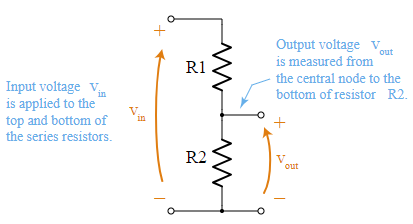
A voltage divider is a simple electronic circuit that divides an input voltage into smaller fractions. It is a fundamental circuit element used in various electronic devices and systems. The voltage divider consists of two or more resistors connected in series, with the output voltage taken from the junction between the resistors.
2.How a Voltage divider works?
The principle behind a voltage divider is based on the concept of voltage division. According to Ohm's Law, the voltage across a resistor is proportional to the current flowing through it. In a voltage divider circuit, the total current flows through the series resistors, and the voltage drop across each resistor is proportional to its resistance value.
The output voltage of the voltage divider is determined by the ratio of the resistor values. The higher the resistance value of a resistor, the larger the voltage drop across it. By carefully selecting the resistor values, it is possible to obtain a desired output voltage from an input voltage source.
3. Formula
The formula/equation for calculating the output voltage of a voltage divider is:
· Vout = Vin * (R2 / (R1 + R2))
where Vout is the output voltage, Vin is the input voltage, R1 is the resistance of the first resistor, and R2 is the resistance of the second resistor.
And there is also another version of the equation, it is similar to the one above:
Vout = (Rout/Rt) x Vin, where:
· Rout = Resistance across the output
· Rt = Total resistance of the circuit
Vout = (Resistance across the output / Total resistance of the circuit) x Vin.
Assuming that the voltage we want to know is V1, we clear this value. V1 = (Vin)(R1)/Rs. We can find V2 and V3 in the same way, using the corresponding resistor value.
Voltage divider Examples
Using the following values: R1 = 1K, R2 = 2K, R3 = 3K and Vin = 12 volts.
1. If we want to know the voltage across resistor R3.
· Vout = Vin x R3 / ( R1 + R2 + R3)
· Vout = 12V x 3K / (1K + 2K + 3K)
· Vout = 12V x 3K / 6K = 12V / 2 = 6V
2. If we want to know the voltage cross resistor R1.
· Vout = Vin x R1 / ( R1 + R2 + R3)
· Vout = 12V x 1K / (1K + 2K + 3K)
· Vout = 12V x 1K / 6K = 12V / 6 = 2V
4. What is a voltage divider circuit?
5.Voltage Divider Applications
Voltage dividers find wide applications in various electronic systems and devices. Some common applications of voltage dividers include:
1. Level Shifting: Voltage dividers can be used to shift the voltage level of a signal. By adjusting the resistor values, the input voltage can be scaled down or up to match the desired voltage level for a particular circuit or component.
2. Sensor Interface: Voltage dividers are often used to interface sensors with microcontrollers or analog-to-digital converters (ADCs). Sensors typically provide a voltage output proportional to the measured quantity. A voltage divider can be employed to scale down the sensor output voltage to a range compatible with the input requirements of the microcontroller or ADC.
3. Biasing Transistors: Voltage dividers are commonly used in transistor biasing circuits. They help establish a specific voltage at the base or gate terminal of the transistor, ensuring proper operating conditions.
4. Reference Voltage Generation: Voltage dividers can be employed to generate reference voltages for various purposes, such as providing a stable voltage reference for analog circuits or establishing a voltage reference for comparison in control systems.
6. What is Voltage Divider Calculator?
To simplify the calculation of voltage dividers, online calculators and software tools are available. These tools require the input voltage and the resistor values, and they provide the output voltage. By using these calculators, engineers and hobbyists can quickly determine the resistor values needed to achieve a desired output voltage.
7.What is the most effective component in a voltage divider?
The most effective component in a voltage divider is the resistor. The resistor determines the division ratio and plays a crucial role in determining the output voltage. By selecting appropriate resistor values, the desired output voltage can be achieved.
8.What is the function of a fixed resistor in the potential divider?
The function of a fixed resistor in a potential divider (another term for a voltage divider) is to determine the division ratio and control the output voltage. The fixed resistor, also known as the load resistor, remains constant and determines the lower boundary of the resistance in the voltage divider circuit. By selecting the appropriate value for the fixed resistor, the desired output voltage can be achieved based on the ratio between the fixed resistor and the variable resistor(s) in the circuit.
A voltage divider circuit is a circuit configuration that consists of two or more resistors connected in series. It is used to divide an input voltage into smaller fractions. The output voltage is taken from the junction between the resistors. A voltage divider circuit does not necessarily require a transistor. It can be implemented using resistors alone.
However, in certain applications, voltage dividers may be used in conjunction with transistors. Transistors can be employed to buffer the output voltage and provide additional functionalities such as amplification or signal conditioning. The transistor acts as an active element in the circuit, modifying the voltage division characteristics and enabling more complex circuit designs.


Frequently Asked Questions
Related Articles

Multiplexing In Networking:Multiplexing & Demultiplexing Examples
How MOSFETS Work?Know Everything About Mosfet:Types,Operation
What Are Biosensors Used For And How Does It Work?
What is a Voltage divider? Function, Formula, Application
What are Different Types of DB Connectors: DB9,DB15,DB25,DB37,DB50
Types of Switches: A Guide to Understanding and Utilizing Them
How Does An IGBT Rectifier Work?
How to Connect to an FTP with a Different Port
Understanding IMU: A Beginner's Guide to Inertial Measurement Units
Exploring the Capabilities of Google's Gemini AI Model: Is It the Best?
Brushless DC (BLDC) Motor Explained:Working Principles, Structure