How MOSFETS Work?Know Everything About Mosfet:Types,Operation
Introduction
MOSFETs (Metal-Oxide-Semiconductor Field-Effect Transistors) are essential electronic components that have revolutionized the field of modern electronics. They form the backbone of numerous electronic devices, ranging from computers and smartphones to power amplifiers and voltage regulators. In this article, we will delve into the inner workings of MOSFETs, exploring their history, composition, operation, applications, as well as their pros and cons.
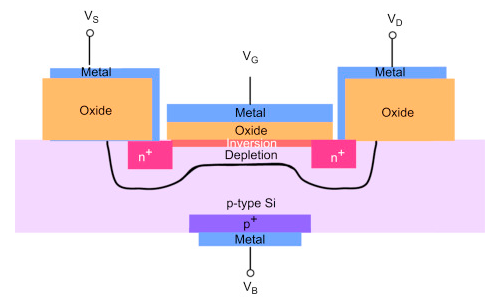
MOSFETS History
Julius Edgar Lilienfeld patented the basic principle of the transistor in 1925. Bell scientists William Shockley, John Bardeen, and Walter Houser Brattain proposed a structure similar to the MOS transistor during their transistor discovery investigation. However, this structure did not exhibit the expected effects due to surface state issues, specifically traps on the semiconductor surface that immobilized electrons. In 1955, Carl Frosch and L. Derick accidentally developed a layer of silicon dioxide on a silicon wafer. Subsequent research revealed that silicon dioxide could prevent dopants from diffusing into the silicon wafer. Mohamed M. Atalla later demonstrated that silicon dioxide effectively addressed the problem of a crucial class of surface states.
Composition
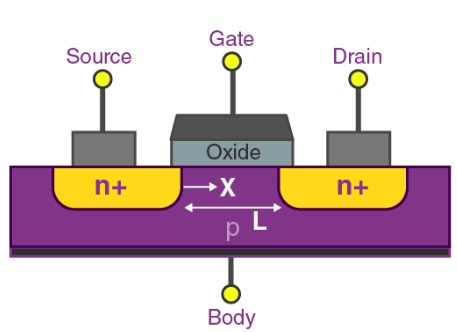
A MOSFET consists of three main components: a silicon semiconductor substrate, a thin layer of insulating material (usually silicon dioxide), and metal contacts. The substrate acts as the foundation, while the insulating layer, known as the gate oxide, separates the substrate from the metal gate. The source and drain regions are doped areas on either side of the substrate, forming a channel that allows the flow of current.
MOSFET Symbol
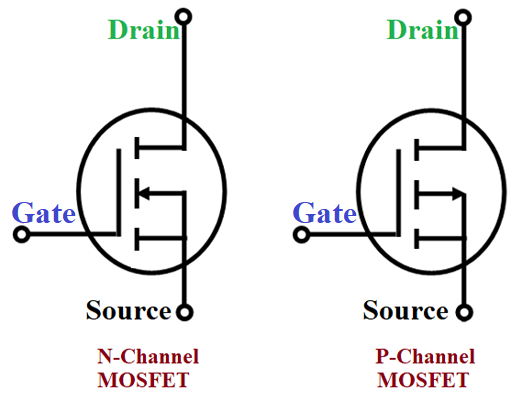
The symbol of a MOSFET, regardless of whether it is an N-channel or P-channel, consists of three terminals: gate, source, and drain.
The gate terminal is represented by a line or triangle connected to the channel symbol, while the source and drain terminals are represented by arrows pointing away from the channel symbol
How to read a MOSFET symbol?
To read a MOSFET (Metal-Oxide-Semiconductor Field-Effect Transistor) symbol, you need to understand the various components and elements represented in the symbol. The MOSFET symbol consists of several parts, each conveying important information about the device. Let's break down the symbol and its components:
Body:
The body of the MOSFET is represented by a rectangular shape, which includes the channel region and the substrate. It forms the base structure for the device.
Gate:
The gate is represented by a horizontal line that intersects the body of the MOSFET. It is insulated from the channel and controls the conductivity of the channel. The gate terminal is used to apply a voltage to control the transistor's behavior.
Source and Drain:
The source and drain terminals are represented by arrows or triangles pointing away from the body. These terminals are responsible for the flow of current through the device. The source is usually connected to the lower arrow, while the drain is connected to the upper arrow.
Doping Polarity:
Some MOSFET symbols may include a small arrowhead near the source terminal, indicating the doping polarity of the channel. The arrowhead points towards the N-type region (narrow end) or the P-type region (wide end) of the channel.
Channel Type:
The type of MOSFET can be determined by the channel type. For an N-channel MOSFET, the channel region is typically represented by a solid line, while for a P-channel MOSFET, the channel region is represented by a dashed line.
MOSFET Pinout

MOSFET Pinout
How MOSFETS Work? (Operation)
The operation of a MOSFET can be understood by considering its three-terminal structure: the gate, source, and drain. The flow of current through the channel is controlled by the voltage applied to the gate terminal. MOSFETs operate in two modes: enhancement mode and depletion mode.
In enhancement mode, the channel is initially non-conductive. When a positive voltage is applied to the gate, it creates an electric field that attracts electrons towards the substrate, forming a conductive channel between the source and drain. This allows current to flow between the source and drain terminals.
In depletion mode, the channel is initially conductive. When a negative voltage is applied to the gate, it repels electrons from the substrate, depleting the channel and reducing the flow of current between the source and drain.
MOSFETS Applications
MOSFETs find a wide range of applications in various electronic devices and systems. Some notable applications include:
1. Digital Integrated Circuits: MOSFETs are the primary components in digital logic gates, microprocessors, memory chips, and other digital circuitry due to their ability to switch on and off rapidly.
2. Power Electronics: MOSFETs are used in power converters, motor control circuits, voltage regulators, and inverters due to their high switching speeds, low power losses, and high power-handling capabilities.
3. Amplifiers: MOSFETs can be used in audio amplifiers, radio frequency (RF) amplifiers, and operational amplifiers, providing high input impedance and low output impedance.
4. Displays: MOSFETs are utilized in organic light-emitting diode (OLED) displays and liquid crystal displays (LCDs) for pixel control and switching.

MOSFETS Pros & cons
MOSFETS Pros:
- High switching speeds enable efficient operation in digital circuits.
- Low power consumption due to negligible current flow in the off state.
- Miniaturized size allows for integration into small-scale devices.
- High input impedance and low output impedance make them suitable for amplifier applications.
- Excellent linearity and frequency response in radio frequency applications.
MOSFETS Cons:
- Sensitivity to electrostatic discharge (ESD) can lead to damage.
- Susceptible to thermal breakdown under excessive power dissipation.
- Complex manufacturing process compared to other transistor types.
- Limited voltage and current handling capabilities compared to other power devices like IGBTs.
The major difference between MOSFET and FinFET
The major difference between MOSFET (Metal-Oxide-Semiconductor Field-Effect Transistor) and FinFET (Fin Field-Effect Transistor) lies in their architecture. MOSFETs have a planar structure, with the gate electrode placed on the top surface of the transistor. FinFETs, on the other hand, have a three-dimensional structure, with the gate surrounding a raised fin-like structure. The FinFET design allows for better control of current flow and reduces leakage current, resulting in improved performance and energy efficiency compared to traditional MOSFETs.
Polysilicon in the gates of MOSFETs
Polysilicon, or polycrystalline silicon, is commonly used in the gates of MOSFETs due to its ability to form a conductive and stable interface with the gate oxide. It is deposited and patterned on top of the gate oxide layer to create the gate electrode. Polysilicon offers good electrical properties, such as high conductivity and compatibility with integrated circuit fabrication processes, making it an ideal choice for MOSFET gates.
Drain-Induced Barrier Lowering (DIBL) in MOSFETs
DIBL refers to a phenomenon in MOSFETs where the threshold voltage decreases as the drain voltage increases. This occurs due to the influence of the drain voltage on the depletion region near the drain region of the transistor. As the drain voltage increases, the depletion region extends further into the channel, resulting in a reduced effective channel length and a lower threshold voltage. DIBL can have a detrimental effect on device performance and is a critical consideration in MOSFET design.
MOSFETs are not linear devices due to their inherent switching behavior. They are primarily designed to operate in either the on-state or the off-state. When a voltage is applied to the gate, the MOSFET transitions rapidly between these states, allowing or blocking the flow of current. The current-voltage relationship of a MOSFET is nonlinear, as the current depends exponentially on the applied gate-source voltage and drain-source voltage. This nonlinearity is a key characteristic of MOSFETs and is utilized in digital circuits for switching operations.
The inductance of a MOSFET
MOSFETs are primarily considered as voltage-controlled devices and do not have an inherent inductance. However, in practical circuits, the parasitic elements associated with the MOSFET's package, die, and interconnections can introduce some level of inductance. This parasitic inductance can affect the device's performance, particularly in high-frequency applications, and needs to be considered in circuit design.
Drain and source interchangeability in MOSFETs
In most cases, the drain and source terminals of a MOSFET are not interchangeable. The MOSFET is designed to have a specific drain-source voltage polarity across its terminals. Reversing the drain and source connections would result in incorrect operation and may lead to device damage. It is essential to correctly identify and connect the drain and source terminals according to the manufacturer's specifications.
Formula for threshold voltage of a MOSFET
The threshold voltage (Vth) of a MOSFET can be calculated using the following formula:
Vth = Vfb + 2√(φf - Φs - Vsb) + γ(2√(φf - Φs - Vsb) - 2√(φf - Φs))
Where:
- Vfb is the flat-band voltage.
- φf is the Fermi potential.
- Φs is the surface potential.
- Vsb is the source-to-bulk voltage.
- γ is the body effect coefficient.
Function of MOSFETs in electronic circuits
MOSFETs serve various functions in electronic circuits, depending on their configuration and application. Some common functions include:
- Switching: MOSFETs can be used as switches to control the flow of current in digital circuits.
- Amplification: MOSFETs are utilized as voltage amplifiers in audio and RF circuits.
- Voltage Regulation: MOSFETs can be employed in voltage regulators and power supplies to stabilize output voltages.
- Current Control: MOSFETs are used in motor control circuits to regulate current flow.
- Signal Processing: MOSFETs play a crucial role in analog signal processing, such as filtering and signal conditioning.
Overall, MOSFETs provide versatile functionality in electronic circuits, allowing for efficient control and manipulation of current and voltage levels.

Types
MOSFETs can be broadly categorized into three types based on their channel structure:
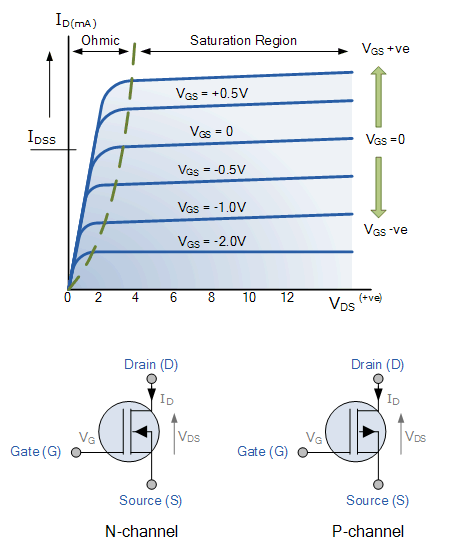

Depletion-mode N-Channel Circuit Symbols Enhancement-mode N-Channel Circuit Symbols
1. Enhancement Mode MOSFETs (E-MOSFETs):
In enhancement mode MOSFETs, the channel is normally off when zero voltage is applied to the gate. These MOSFETs require a positive voltage at the gate to create an electric field that attracts carriers and forms a conductive channel between the source and drain. They are commonly used in digital circuits and require an external voltage to turn them on.
2. Depletion Mode MOSFETs (D-MOSFETs):
In depletion mode MOSFETs, the channel is normally on when zero voltage is applied to the gate. These MOSFETs require a negative voltage at the gate to deplete the channel and reduce the flow of current between the source and drain. They can be used as current-controlled resistors or in applications requiring normally conducting channels.
3. Power MOSFETs:
Power MOSFETs are designed to handle high voltages and currents, making them suitable for power electronics applications. They are typically enhancement mode MOSFETs and offer low on-resistance and high efficiency. Power MOSFETs are commonly used in power supplies, motor control, inverters, and other high-power applications.
Additionally, MOSFETs can be classified based on their channel conductivity type:
1. NMOS (N-channel MOSFET):
NMOS MOSFETs also known as n channel mosfet, mosfet symbol have an n-type channel, where electrons are the majority carriers. They require a positive voltage at the gate to turn on and allow current flow between the source and drain.
2. PMOS (P-channel MOSFET):
PMOS MOSFETs ( p channel mosfet,) have a p type channel, where holes are the majority carriers. They require a negative voltage at the gate to turn on and allow current flow between the source and drain.
PMOS devices operate in a complementary manner to NMOS devices, with their conductive state being established by applying a negative gate voltage. This characteristic makes PMOS MOSFETs suitable for specific applications where a negative gate voltage is preferable for control and switching operations.
Classification
Metal-Oxide-Semiconductor Field-Effect Transistors (MOSFETs) can be classified in several ways based on different criteria. Here are some common classifications:
1. **By Structure:**
- **Enhancement Mode MOSFETs:** These MOSFETs require a gate-source voltage to be applied to create a conducting channel between the source and drain terminals.
- **Depletion Mode MOSFETs:** These MOSFETs are normally ON and require a gate-source voltage to be applied to turn them OFF by depleting the channel.
2. **By Channel Type:**
- **NMOS (N-channel MOSFET):** The majority carriers are electrons.
- **PMOS (P-channel MOSFET):** The majority carriers are holes.
3. **By Operating Region:**
- **Cut-off Region:** Both junctions are reverse-biased.
- **Triode (or linear) Region:** The transistor operates as an amplifier.
- **Saturation Region:** The transistor is fully ON, and acts as a closed switch.
4. **By Voltage Rating:**
- **Low-Voltage MOSFETs:** Designed for low-voltage applications.
- **High-Voltage MOSFETs:** Designed for high-voltage applications.
5. **By Application:**
- **Power MOSFETs:** Designed to handle high power levels.
- **RF MOSFETs:** Optimized for radio frequency applications.
6. **By Technology:**
- **Planar MOSFETs:** Traditional flat MOSFET structure.
- **FinFETs (Tri-Gate MOSFETs):** 3D structure with improved control over the channel.
Conclusion
MOSFETs have become indispensable in modern electronics, enabling the development of smaller, faster, and more efficient devices. Their ability to control the flow of current through an electric field generated by the gate voltage has made them a vital component in digital circuits, power electronics, amplifiers, and displays. While they offer numerous advantages, it's crucial to consider their limitations and ensure proper protection and cooling mechanisms are in place for optimal performance. With ongoing advancements in semiconductor technology, MOSFETs are expected to continue evolving and shaping the future of electronics.


Frequently Asked Questions
Related Articles

What is a microprocessor: The Brain of Modern Computing
Understanding the Central Processing Unit (CPU)
Leveraging AI to Combat Telecom Fraud
LHDC, LDAC, aptX, AAC, SBC: Bluetooth Audio Codecs Comparison
RASPBERRY PI 5 VS RASPBERRY PI 4: The Detailed Differences & Similarities
What is PMIC, How PMIC works
Active Vs Passive Components: Comparison
LED Strip Lights Explained: Types, Applications, Pros and Cons
The Powerhouse of Data Centers: Exploring AMD EPYC Processors
Exploring the World of Digital Signal Processor
RX 6800 vs RTX 4060 Ti 16GB: A Battle of Graphics Powerhouses